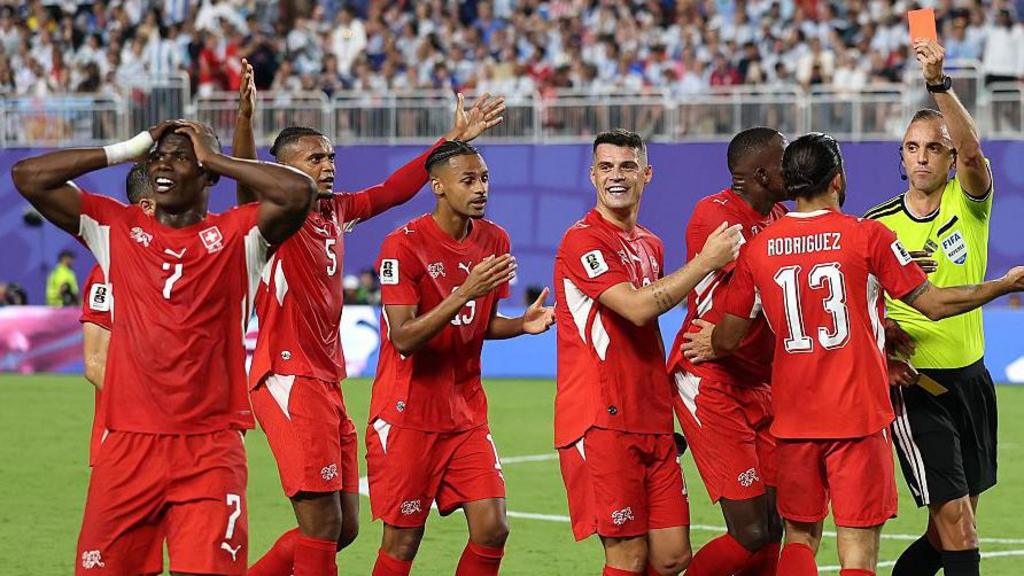
Switzerland forward Breel Embolo has entered the World Cup history books for all the wrong reasons. During the quarter-final against Argentina in Kansas City, Embolo became the first player ever to be sent off under FIFA’s new mistaken identity rule at a World Cup.
What Happened?
The incident occurred during a tense quarter-final between Argentina and Switzerland. Embolo was shown a red card after officials determined he had been mistakenly identified as the player who committed a serious foul. Under FIFA’s updated laws of the game, when a referee sends off the wrong player, the correction can be made — and the originally carded player can be dismissed instead once the error is identified.
The red card left Switzerland down to 10 men for the remainder of the match, a blow that proved decisive as Argentina went on to win 3-1 after extra time to set up a semi-final against England.
What Is the Mistaken Identity Rule?
FIFA introduced the mistaken identity provision to address situations where referees show a card to the wrong player. This can happen in crowded penalty areas, during set pieces, or when multiple players are involved in an incident.
The rule works as follows:
- If a referee shows a yellow or red card to the wrong player, the video assistant referee (VAR) can alert the official
- The original card is rescinded from the wrongly identified player
- The correct player receives the appropriate sanction
- If it was a red card, the actual offender is dismissed
This is different from a standard VAR review, which checks for clear and obvious errors in decision-making. The mistaken identity rule specifically addresses cases of wrong player identification.
Why This Is Significant
Before this World Cup, the mistaken identity rule had rarely been used at the highest level. Its application in a World Cup quarter-final — with millions watching worldwide — has brought massive attention to the regulation.
The incident raises important questions about how referees identify players in high-pressure moments. With players wearing similar kits and moving at speed, mistakes can happen. VAR technology now provides a safety net, but the human element of officiating remains a challenge.
The Impact on Switzerland
Embolo’s dismissal was a turning point in the match. Switzerland had been competitive throughout the game, but losing a key forward forced them into a defensive posture. Argentina took advantage, scoring twice in extra time to seal a 3-1 victory.
For Embolo, the red card was especially painful. The Monaco forward had been one of Switzerland’s best performers at the tournament, and his presence was crucial to their attacking threat.
What This Means for Football
The incident is likely to spark debate about the mistaken identity rule and its application. Some will argue it is a necessary correction that ensures fairness. Others may feel that the disruption of sending off a player mid-match — especially when the original error was the referee’s — is too harsh.
What is clear is that VAR continues to reshape how the game is officiated. The Embolo incident is the latest example of technology intervening in ways that would have been impossible just a few years ago.
What to Watch
As the World Cup continues, expect more discussion around VAR and the mistaken identity rule. Referees will likely be more cautious about identifying players before issuing cards, and teams may need to be prepared for the possibility of late corrections to on-field decisions.
The Embolo red card will be remembered as a landmark moment — the first time a World Cup player was sent off under a rule designed to fix the referee’s own mistake.